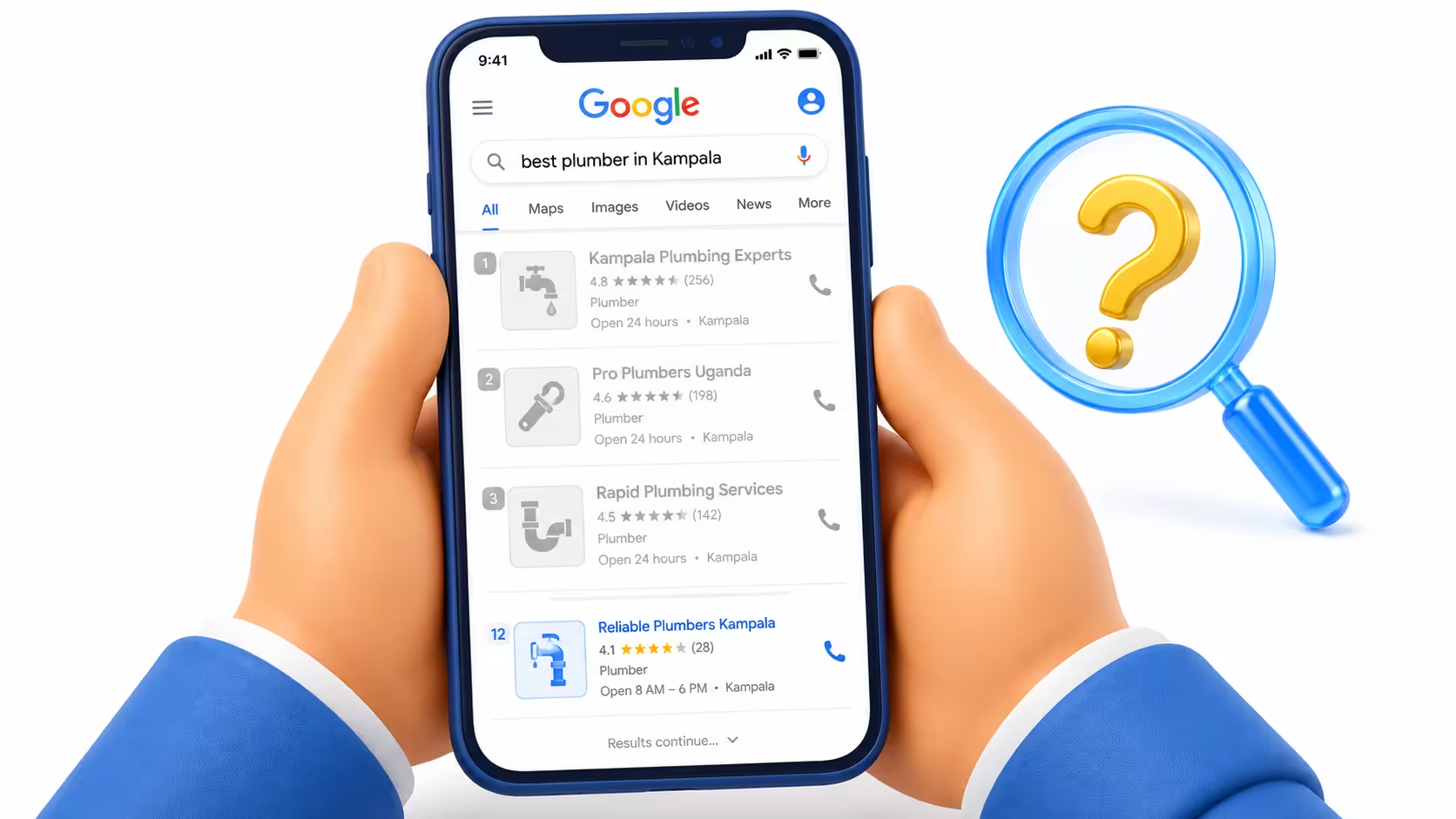
Someone in Kampala just searched for exactly what you sell.
They typed it into Google. A result appeared. They clicked it, called the number, and became a customer today.
That result was not yours.
This happens to Uganda businesses hundreds of times a day. Good products. Real expertise. Invisible on the one platform where customers are already looking.
That is what SEO fixes. Not tricks. Not shortcuts. A specific, learnable system for getting your business in front of people who are already searching for you.
This guide covers all of it: what SEO actually is, how Google decides who ranks, keyword research, on-page optimisation, local SEO, technical SEO, content, backlinks, realistic timelines, and whether to do it yourself or hire someone. Written for Uganda businesses specifically, not translated from a guide built for the US or UK market.
Updated 2026. Written by Francis Baguma, founder and senior SEO strategist at Elite Webmasters.
What Is SEO and Why Does It Matter for Uganda Businesses?
SEO (search engine optimisation) structures a website so Google can find it, understand it, and rank it above competitors. It targets the exact searches your customers actually type in. Done well, it brings customers to you every day without paying for ads.
Compare that to paid ads, where traffic stops the moment you stop paying. SEO compounds instead. A ranking you earn in month three often still brings customers in month twelve, at no extra cost per visitor.
Here is the business case in one number. Say your website brought you five new clients a month, each worth UGX 2,000,000. That’s UGX 10,000,000 a month in revenue, and the traffic is free once you rank. Most Uganda businesses are leaving that number on the table because their website is invisible on Google.
Proof: Uganda Businesses Are Already Winning With This
Uganda’s internet usage is overwhelmingly mobile-first. Most local searches now happen from a phone, with the searcher already close to a buying decision. SEO puts your business in front of that person at the exact moment they’re deciding where to go.
Easy Power Company, a solar and electrical contractor in Uganda, is the clearest proof of this. Before working with us, their site pulled around 500 weekly visitors, most of whom already knew the brand by name. Within 30 days, that grew to over 1,200 weekly visitors, with top 3 rankings for their main commercial keywords. More than 300 million UGX in revenue has been tracked back to organic search. Nothing about their product changed. What changed was whether Google could find them.
That is the point of this guide: not ranking for its own sake. It’s about making sure customers already searching for what you sell find you, not the competitor next door.
How Google Decides Who Ranks #1 in Uganda
Google ranks pages using three pillars. Get all three right and rankings tend to follow. Get one wrong and it caps everything else you do, no matter how much effort goes into the other two.
1. Relevance
Does your page actually answer what someone searched? Google reads your titles, headings, and content to judge whether your page matches the intent behind a search. A page about solar panels ranks differently for “solar panel price Kampala” than it does for “how solar panels work.” Relevance means writing for the specific question, not the general topic.
2. Authority
Does Google trust your site? Authority comes from other reputable websites linking to yours, and from people clicking your result and staying on the page. It also comes from a track record of publishing accurate, useful content over time. A brand-new domain starts with zero authority and has to earn it.
3. Technical health
Can Google actually read and rank your site? A slow site makes it harder for Google to crawl your content. So does a site with no mobile-friendliness, or one with broken pages and no sitemap. That’s true no matter how good the content is. Technical problems act as a ceiling on everything else you do.
Miss any one of the three and rankings stall. Most Uganda business sites we audit have real gaps in all three at once. There’s solid content but no keyword research (no relevance). There’s a new domain with zero backlinks (no authority). And there’s a slow WordPress install nobody has touched since launch (no technical health).
In practice, this is why fixing just one thing rarely moves the needle. A business owner who publishes great content but never fixes a broken sitemap sees no improvement. They conclude “content doesn’t work,” when the real problem was technical. A business that fixes every technical issue but never does keyword research ranks for nothing anyone searches. The three pillars work together. A proper SEO audit checks all three before recommending anything. That’s the whole reason a scattered, one-off fix rarely produces the same result as a coordinated strategy. We cover the most common causes in a dedicated piece: why most websites in Uganda don’t rank on Google.

Keyword Research for Uganda Businesses
Keyword research means finding the exact words your customers type into Google. Then you build your website around those words, instead of the words you’d use to describe your own business.
Business owners often use different language than customers. You might call it “residential solar installation”. Your customer types “solar panels for home Kampala price”.
Free method: Google autocomplete. Type your service into Google and see what it suggests before you finish typing. Those suggestions are real, common searches. Do this in an incognito window from a Uganda location. That way, the suggestions reflect local search behaviour, not your personal search history.
Paid tools: Ahrefs and SEMrush go further, showing search volume, competition level, and what your competitors already rank for. We use both for every client, because guessing at demand wastes months of work on the wrong terms.
Short-Tail vs Long-Tail Keywords
Short-tail keywords (“solar panels Uganda”) carry the highest search volume and the highest competition. Long-tail keywords (“residential solar panel installation cost Kampala”) carry less volume individually. But they’re easier to rank for, and the person searching is closer to buying. A new or smaller site should target long-tail first, then expand into short-tail as authority builds.
Here’s what that looks like laid out for one business, a solar installer in Kampala:
- Short-tail (high volume, high competition): “solar panels Uganda”, “solar installation Kampala”
- Mid-tail (moderate volume, moderate competition): “residential solar panels Kampala”, “solar panel installer near me”
- Long-tail (lower volume, low competition, high buying intent): “cost of installing solar panels for a 3-bedroom house Kampala”
A brand-new site targeting only short-tail terms will likely wait months for any movement. It’s competing against established players with years of authority. The same site targeting long-tail terms can realistically rank within weeks and start generating enquiries. That early traction can then justify going after the harder, higher-volume terms later.
On-Page SEO: Optimising Your Uganda Website Pages
On-page SEO means optimising the elements on each individual page so Google understands what it’s about. It also helps a visitor who lands on the page actually convert.
The On-Page SEO Checklist
Here is the checklist we run on every page:
- Title tag: includes your primary keyword and stays under 60 characters so it doesn’t get cut off in search results.
- Meta description: a genuine, specific summary under 160 characters, not filler. This doesn’t directly affect ranking, but it affects whether someone clicks your result.
- One H1 per page: the main headline, stating clearly what the page is about.
- H2s and H3s: break the content into a logical structure, each one targeting a related question or subtopic.
Links, Length, and Schema
- Internal links: every page should link to at least two or three other relevant pages on your site. It should also be linked to from somewhere else on the site. Pages nothing links to rarely rank.
- Content length: long enough to fully answer the question, no longer. A pricing page might need 800 words. A comprehensive guide might need 4,000. Match the depth to the intent.
- Schema markup: code that tells Google exactly what it’s looking at. Think a business, an FAQ, a review, or a product. It doesn’t directly boost rankings. But it earns rich results, like star ratings, FAQ dropdowns, or business info. These take up more space and pull more clicks.
Most Uganda business websites we audit have none of this done deliberately. Default WordPress titles, no meta descriptions, sometimes multiple H1 tags from a page builder default. And zero schema markup anywhere on the site. This is often the fastest fix available, because it requires no new content, just correcting what already exists.

Local SEO: Getting on Google Maps in Uganda
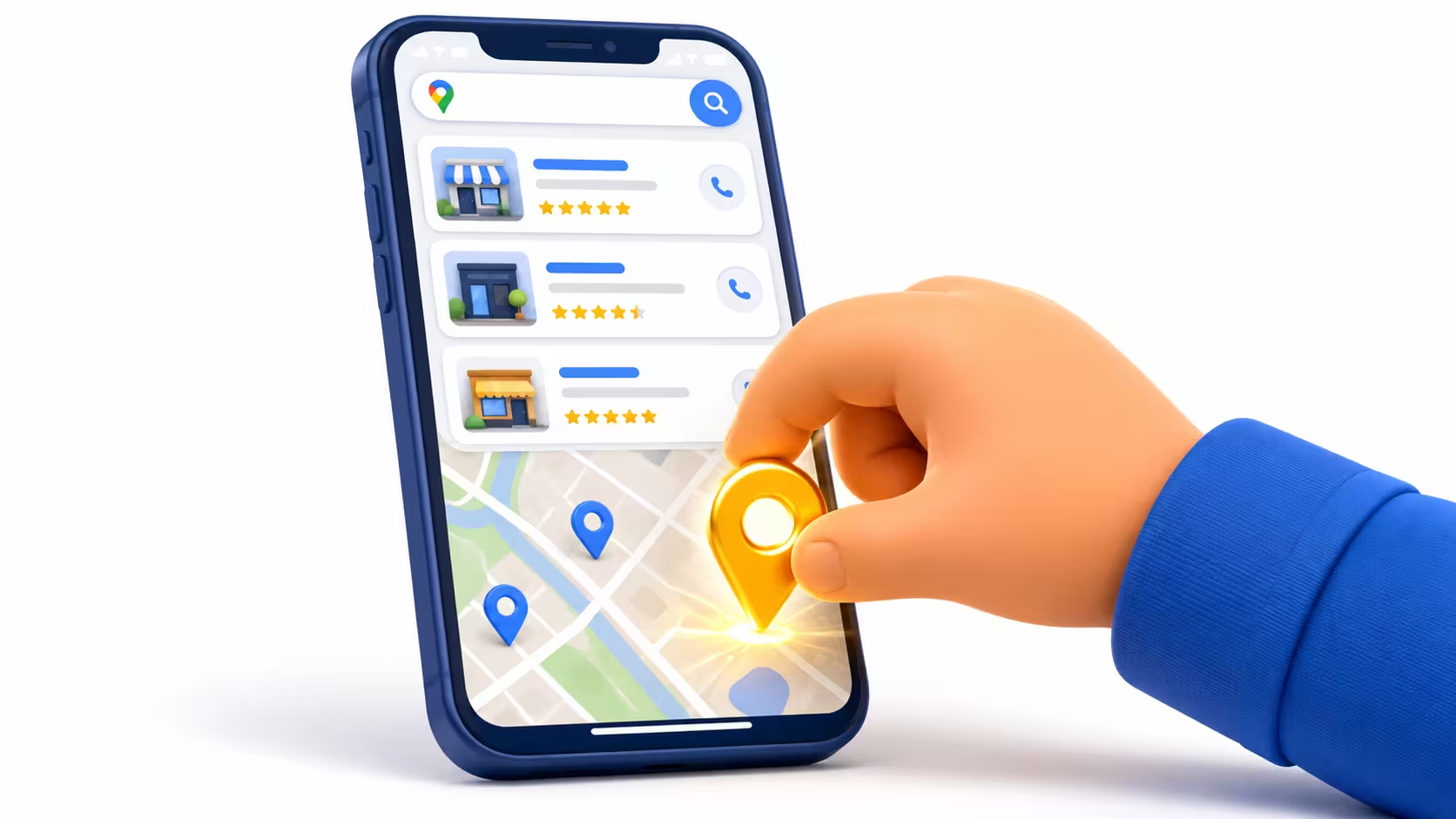
Local SEO is what gets you into the three-listing Google Maps Pack. That’s the block that appears above the organic results whenever someone searches “[your service] near me.” For most local businesses in Uganda, that single result matters more than ranking first in the regular listings below it.
Three things drive it. First, a fully completed Google Business Profile. Second, consistent business information, name, address, and phone number, across every directory that lists you. Third, a steady flow of Google reviews.
We cover the full step-by-step setup in our local SEO and Google Maps guide. This section deliberately stays brief so you can go there for the details. The short version: claim and verify your listing, and complete every field. Add real photos, and ask happy customers for reviews consistently, rather than in one bulk push.
Two numbers worth knowing here. Google Business Profiles with photos get 30 to 50% more views than profiles without them. And 46% of all Google searches carry local intent. That means the searcher wants a business near a specific place, not general information. Together, a neglected GBP listing turns away close to half the demand already searching for what you sell. And that’s before your website even enters the picture.
Why NAP Consistency Matters
NAP consistency deserves a specific mention, because it’s the local ranking factor businesses most often get wrong without realising it. Say your business is listed as “Easy Power Co.” on your website and “Easy Power Company Ltd” on Facebook. Add “Easy Power” with a different phone number on an old directory listing. Google reads that as uncertainty about whether these are the same business. It quietly holds back your Maps ranking trust.
Auditing every place your business is listed online is unglamorous work. So is making the name, address, and phone number identical everywhere. But it’s one of the highest-leverage fixes available for local visibility.
Technical SEO: What Your Website Needs to Be Crawlable
If Google can’t read your site, it can’t rank it. It’s like a book with no table of contents and no index. Nearly impossible to navigate, even when every chapter is well written.
- Speed: pages should load in under 3 seconds. 53% of mobile visits are abandoned if a page takes longer than that to load (Google).
- Mobile-friendliness: Google ranks the mobile version of your site first. If it’s hard to use on a phone, it’s hard to rank.
- HTTPS: your site needs a valid security certificate. Google flags sites without one as “not secure,” which damages trust before a visitor reads a word.
- An XML sitemap: a file listing every page on your site. Submit it to Google Search Console so Google knows what to crawl.
- A correct robots.txt file: tells Google which parts of your site to crawl and which to skip. Misconfigured, it can accidentally block Google from your entire site.
The Uganda Hosting Problem Nobody Checks
These are invisible to visitors and easy to ignore. That’s exactly why they’re the most commonly neglected part of SEO in Uganda. A site can look polished and still be functionally invisible to Google underneath.
One Uganda-specific issue worth flagging: a lot of local business sites are hosted on servers physically located outside East Africa. That adds real latency for both Uganda visitors and Google’s crawlers. Combined with unoptimised images and no caching, this explains most “site loads too slowly” problems we find in audits. Fixing hosting and caching is often a bigger speed win than anything you can do on the page itself.
Content Marketing for Uganda Businesses
Content marketing means publishing pages and articles that answer real questions your customers are asking. It builds long-term authority and gives Google more reasons to send you traffic.
53% of all website traffic globally comes from organic search (BrightEdge). Content is how you earn a share of it. Every well-optimised article is a new entry point into your site, working long after you publish it. Compare that to a social media post, forgotten within a day.
Choosing What to Write About
To plan topics, start with the questions your customers actually ask before they buy. A solar company might answer, “How much do solar panels cost in Uganda?” or “How long do solar panels last?” Each becomes an article.
Not every piece needs to be a long guide. A useful content mix includes comparison articles, cost breakdowns, and location-specific pages if you serve multiple towns. It can also include honest answers to objections customers raise on sales calls. If your sales team hears the same question every week, that question is a content brief waiting to be written.
Quality Beats Quantity Every Time
Quality matters more than any of this, though. Google’s own guidance on “helpful content” comes down to three questions: who created it, how, and why.
A page written purely to hit a word count, with no real expertise behind it, tends to underperform. That’s true even when it’s technically optimised correctly. A page written by someone who has actually solved the problem tends to outperform far more polished but shallower competitors. This matters more now than a few years ago, since Google keeps tightening its core updates around exactly this distinction.
Consistency matters more than volume. One well-researched article a month, sustained for a year, beats ten rushed ones published in a week and then abandoned. Part of Easy Power’s SEO strategy was exactly this: content built around the specific commercial keywords their customers typed. It was published consistently, rather than in one burst. That consistency helped take them from page 1 for one branded term to top 3 rankings across multiple commercial terms.

Backlinks: Why Other Websites Linking to You Matters
A backlink is a link from another website to yours. Google treats it as a vote of confidence. If other sites link to you, you’re probably worth ranking.
Uganda-specific sources worth pursuing:
- Local business directories with a real editorial process, not spam link farms.
- Uganda news and industry sites covering your sector. A journalist quoting you for a story is a natural, high-value link.
- Partner businesses and suppliers who already reference you, or would if asked. A supplier’s “our dealers” page is an easy, legitimate link.
- Chambers of commerce and industry associations you’re already a member of. Many have a member directory with a link to your site.
- Sponsorships and community involvement, which frequently earn a mention and a link from the organiser’s website.
What to avoid: bought links, link farms, or any service promising “100 backlinks for $50.” These almost always come from low-quality or penalised sites. Google’s algorithm is specifically built to detect and penalise exactly this pattern. A handful of real, relevant links beats hundreds of purchased ones. Recovering from a link-based penalty can also take longer than building the links properly in the first place.
How Long Does SEO Take in Uganda?
Honest timelines, because any agency promising otherwise is either wrong or not being straight with you.
- Google Business Profile: 24 to 72 hours to go live once verified.
- On-page fixes: measurable ranking movement in 4 to 8 weeks.
- Competitive keywords: 3 to 6 months for meaningful movement.
- A brand-new domain: 6 to 12 months to build enough authority to compete for anything contested.
Easy Power’s 30-day result was a best case. It had an existing domain with real history and fixable technical problems, not a brand-new site starting from zero. We give every client a realistic timeline before any work starts. It’s based on their specific starting point, not a marketing promise.
What makes a starting point faster or slower usually comes down to a few honest factors. How old is the domain? Does it already have any backlinks or search history? How competitive are the target keywords? And how many technical issues need fixing before growth work can even begin? Two businesses in the same industry can have very different timelines for exactly these reasons. That’s why any agency quoting a fixed timeline before looking at your actual site is guessing, not analysing.
DIY SEO vs Hiring an Agency in Uganda
An honest framework, not a sales pitch.
DIY works if: you have the time to learn it properly. It also works if your keyword competition is genuinely low, like a hyperlocal service. And it works if you’re comfortable with a slower timeline while you learn.
Hiring works if: you’re in a competitive category, or you’ve already tried and seen no movement. It also works if your time is worth more than the hours it takes to learn SEO properly.
The Real Cost of Learning It Yourself
Be honest about the real cost of DIY, too. Learning technical SEO, keyword research, and content strategy to a professional standard takes months, not a weekend of reading. That time has a real cost, even if no invoice ever gets sent for it. For a hyperlocal business with light competition, that trade-off can make sense. Picture a business in a crowded Kampala market, against competitors already investing in professional SEO. DIY is often the pricier option there. It’s just paid in time instead of money.
If you decide to hire, know what to look for first. We’ve written a full breakdown of how to choose an SEO agency in Uganda without getting burned. There’s also a companion piece on the 5 questions to ask before you pay anyone. Read either one before you sign anything, including with us. For reference, Elite Webmasters is a DesignRush Verified Agency, listed among vetted SEO agencies for exactly this kind of due diligence.
For the full cost breakdown, see our SEO pricing guide for Uganda. One-time audits start at $150, monthly retainers from $400. The audit is the lowest-risk starting point either way. It tells you exactly what’s wrong, whether you fix it yourself or hire someone to.

Uganda SEO FAQ
How much does SEO cost in Uganda?
One-time audits start at $150. Monthly retainers start at $400. The right price depends on your keyword competition, your site’s current technical condition, and how much ongoing work is needed. See our full pricing breakdown for real numbers at every tier.
How long does SEO take to work?
Is SEO better than paid ads for a Uganda business?
Do I need a website if I already have a Google Business Profile?
What's the difference between local SEO and regular SEO?
Can a small business compete with bigger, established competitors on Google?
How often does Google change its algorithm, and does that affect my rankings?
Do I need to publish new content every week?
Is SEO different for e-commerce vs service businesses in Uganda?
What tools do you use for SEO?
Can I rank without any backlinks?
What happens if I stop paying for SEO?
Do social media posts help my Google rankings?
How do I know if my current SEO is actually working?
I already tried SEO and it didn't work. Why would this be different?
Where to Go Next
This guide covers the full picture. If you want the specific breakdown for any one piece, here’s where to go:
- Want real pricing? See what SEO actually costs in Uganda
- Comparing agencies? 5 questions to ask before you hire anyone. Or read the fuller guide to choosing an SEO agency
- Not ranking at all? Why most websites in Uganda don’t rank on Google
- Not on Google Maps? Our local SEO and Google Maps guide or see our local SEO services
- Want to know exactly what’s wrong with your site? Get a free SEO audit
- Want proof first? Read the full Easy Power case study
- Want a website built to rank from day one? See our web design services, including WordPress website design built for SEO
vers the full picture. If you want the specific breakdown for any one piece, here’s where to go:
- Want real pricing? See what SEO actually costs in Uganda
- Comparing agencies? 5 questions to ask before you hire anyone. Or read the fuller guide to choosing an SEO agency
- Not ranking at all? Why most websites in Uganda don’t rank on Google
- Not on Google Maps? Our local SEO and Google Maps guide or see our local SEO services
- Want proof first? Read the full Easy Power case study
- Want a website built to rank from day one? See our web design services, including WordPress website design built for SEO
Or skip straight to finding out where your own site stands. We’ll crawl your site, compare you to top Uganda competitors, and hand you a prioritised action list. It’s the same starting point every client on this page has gone through, including Easy Power.
If you want us to handle this for you — see what we offer or get in touch directly.
Ready to Find Out What Your Site Actually Needs?
We crawl your site, identify every problem holding it back, and compare you to your top Uganda competitors. Then we give you a specific action plan.
No obligation. No sales pressure. Just a clear, honest picture of where you stand on Google today.
Francis Baguma is the founder and senior SEO strategist at Elite Webmasters. He has 7+ years of SEO experience and works directly with every client, no account managers, no junior staff. Learn more about how we work →